
Snuff is tobacco taken without fire. It is made from dried leaf, ground fine, and blended with oils and essences. It is taken into the nose, not smoked. A pinch is set on the back of the hand or between finger and thumb and drawn in with a sharp breath. The word itself comes from the sound it makes when you do it.
People have taken snuff since at least the fifteenth century, and likely long before that. Native American peoples were seen drawing powdered tobacco through hollow tubes. Later, during the War of the Spanish Succession, English ships captured a convoy off the coast of Spain. Among the cargo was snuff. Much of it ended up in the coffee houses of London, where doctors and men of standing adopted the habit. At the time, tobacco was believed to cure most things, and snuff was sold openly in apothecaries.
By the eighteenth century, Kendal had become the center of snuff making in Britain. Tobacco from North America came into west coast ports like Whitehaven, Workington, and Maryport, then traveled inland. Kendal already had strong trade in wool, leather, and shoes, and the roads were good. Though much of the tobacco trade later shifted to Glasgow, Kendal held its place. It sat on the pack-horse routes between England and Scotland and served as a natural stopping point.
Those pack horses did more than carry leaf. Their panniers shifted and knocked together, breaking the tobacco into dust and stalks along the way. By the time it reached Kendal, much of it was already ground fine. Local traders bought it cheaply and turned it into snuff.
The rivers sealed the town’s fate. Kendal and its tributaries powered more than forty water-driven mills in the seventeenth and eighteenth centuries. Three of them ground snuff.
In 1790, Thomas Harrison of Kendal, the original Samuel Gawith’s grandfather, traveled to Scotland to learn the craft. He returned with the recipe and machinery for what became known as Kendal Brown. That knowledge began the snuff trade that would define the town.
The House of Samuel Gawith was founded in 1792. The machinery from Scotland was installed in an old water-powered mill outside Kendal. The first snuff produced was Kendal Brown. It is still made today. When others tried to copy it, the word “Original” was added to the label. It was not marketing. It was fact.
In 1878, the brothers Samuel and John Edward Gawith ended their partnership. Samuel kept the snuff mill and built the Kendal Brown House. The company later made pipe tobacco, and for a short time, cigarettes and cigars. But snuff remained the core.
The business grew. During the First World War, demand increased sharply, especially for snuff. By 1918, expansion was necessary. A new factory opened on Sandes Avenue in 1920. The old machinery was moved there and powered by electricity instead of water. The Kendal Brown House became home to offices, packing, and finishing.
After the First World War, the company expanded again, acquiring the snuff machinery of William Nevinson in Penrith. For a time, snuff was produced in both Kendal and Penrith. But the decade was hard on small tobacco firms. Cigarettes grew more and more popular. Large cigarette companies used incentives, like coupons, trading cards and such to dominate the market. Samuel Gawith chose to focus only on snuff. In 1937, production was brought back under one roof at the Kendal Brown House.
In the first third of the twentieth century, the company produced sixty-five different snuffs. These included Doctor Verey’s, Golden Glow, After Glow, Mastiff, and many versions of Kendal Brown. Snuff remained the pride of the house. Even in the 1980s, fifty-seven varieties were still being made. Some of the flavorings later appeared in pipe tobaccos, including FireDance and Celtic Talisman.
Across town, Gawith Hoggarth & Co operated their own watermill on the south side of Kendal, grinding snuff until 1991. Once producing more than forty varieties, they still make a small selection today. Among them is CM Snuff, long known for its menthol.
After Gawith Hoggarth acquired Samuel Gawith in 2015, the tradition continued. Today, eighteen Samuel Gawith snuffs remain in production, offered in small dispensers and vacuum-sealed tins. The method is old. The work is careful. And the tobacco is still ground the way it always was, because it works.
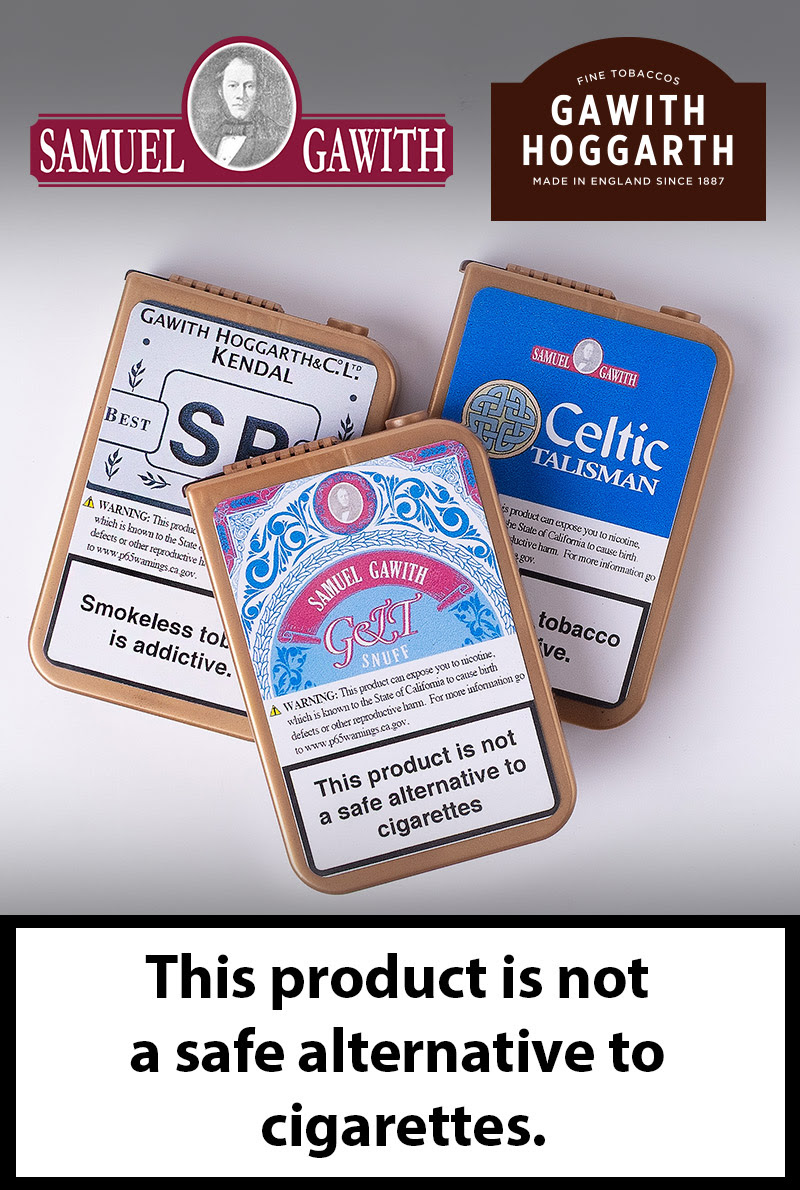
Laudisi Enterprises, the US distributer of the two company’s highly successful pipe tobaccos of has recently introduced to tobacconists a limited line of snuffs from both Samuel Gawith and Gawith & Hoggarth — as of December 2025, four from each company.
SAMUEL GAWITH SNUFF
- Celtic Talisman: Celtic Talisman is a light brown, finely milled nasal snuff with notes of ripe Kirsch cherries.
- FireDance: Zesty, finely milled nasal snuff with refreshing notes of menthol.
- Gin & Tonic (G&T): Light- to medium-brown, finely milled nasal snuff with subtle notes of apricot.
- Keswick: Light-colored, finely milled nasal snuff with notes of pine and menthol.
Read full descriptions here >>>
GAWITH & HOGGARTH SNUFF
- CM Blend: Refreshing, light-colored snuff with notes of menthol and camphor.
- Cafe Regal: Rich, medium-brown snuff with hints of coffee and vanilla.
- Special “M”: An all-day snuff blend with notes of menthol and peppermint.
- SP Blend: Bright, subtly floral snuff with notes of citrus, lavender, and rose.
Read full descriptions here >>>
WARNINGS: It’s important to the Federal Government that we tell you the following:
- Smokeless tobacco is addictive.
- This product is not a safe alternative to cigarettes.
***
